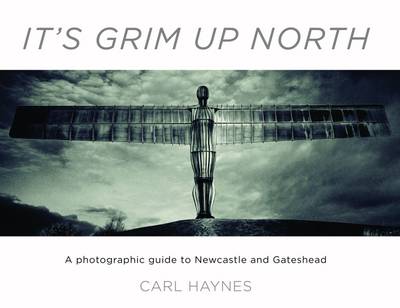
The theme for SyNoBI 2026, “Still Grim Up North?” originates in a long-standing and widely mediated vision of the North of England as a grey, working-class, rain-soaked and economically depressed region—abandoned, marginalised, and frozen in a defunct industrial past. Popularised by J. B. Priestley’s English Journey (1934), written at a moment of profound industrial and social transformation, and later reinforced by the song It’s Grim Up North (1990) by The KLF, this imagery has also been powerfully conveyed through visual media, notably inthe photography of Tish Murtha at the end of the 1970s (Youth Unemployment, 1981) and in the films of directors such as Ken Loach (Kes, 1969; The Old Oak, 2023). Together, these cultural productions have crystallised a persistent representation of the North of England as a space of industrial decline and social tension. With its often caricatural aesthetic of greyness and labouring everyday life, the North occupies a central position in the British cultural imagination, perceived simultaneously as a site of social relegation and suffering and as the cradle of a vibrant and resistant popular culture (Russell, 2004; Kirk, 2017; Spracklen, 2018). In the spirit of exhibitions such as The Great Exhibition of the North, held in Newcastle upon Tyne in 2018, this conference invites participants to reconsider these representations and their evolution across a range of artistic fields.
In literature, numerous writers have depicted a raw, post-industrial North haunted by its mining or textile past, while foregrounding linguistic vitality and close attention to social detail. This is evident in the works of David Storey, Pat Barker, Melvin Burgess and Benjamin Myers. Northern realist fiction continues to coexist with more experimental forms that either deconstruct entrenched stereotypes or engage with them self-consciously.
In theatre, the tradition of kitchen-sink drama, which emerged in the 1950s (Mello, 2024) and was carried forward by the group of writers known as the Angry Young Men (Carpenter, 2002), has exerted a lasting influence on representations of the North. Themes of class conflict, fractured masculinities, repressed sexuality and social entrapment remain central. Contemporary playwrights such as Simon Stephens and Jim Cartwright revisit this legacy while addressing the post-industrial and multicultural realities of the present.
British cinema has likewise repeatedly returned to the North as a site of despair but also of struggle and resilience. The films of Ken Loach (Kes, 1969; The Navigators, 2001), Mike Leigh and Mark Herman (Brassed Off, 1996; The Full Monty, 1997) depict economic precarity alongside humour, solidarity and music. Ranging from dark comedy to social tragedy, these works contribute to an aesthetic of the “grim” tempered by humanity (Mazierska, 2017).
British television has also played a crucial role in shaping the image of the North as a space of social precarity, familial solidarity and personal transformation. Series such as Coronation Street (1960–), Shameless (2004–2013), Happy Valley (2014–2023) and This Is England ’86 (2010), ’88 (2011) and ’90 (2015) exemplify the distinctive blend of social tragedy and popular comedy that characterises Northern representation. Through characters that are sometimes caricatural yet deeply human, these programmes address poverty, social exclusion and tensions between modernity and working-class heritage. Television has thus ensured sustained visibility for Northern imaginaries, exploring generational tensions, social fractures and cultural richness.
Any form of media or theatrical dissemination is inevitably accompanied by a distinct linguistic colouring associated with the North. This colouring has been reinforced by major figures in English literature such as Sheridan and Daniel Defoe, by popular song (Hermeston, 2009), and by its mediation in the 1940s through BBC radio programmes such as Wot Cheor Geordie. More recently, it has been popularised by figures such as Melvyn Bragg on the radio programme In Our Time, as well as by television personalities Ant & Dec and the singer Cheryl Cole (Di Martino, 2019). While certain public figures contribute to the circulation of emblematic Northern speech forms, Northern varieties in fact constitute a spectrum of linguistic shades that both diverge and intersect through their lexicon, morphosyntax (Beal & Corrigan, 2005), and systems of phonetic variation (Haddican et al., 2012; Ferragne & Pellegrino, 2010; Amand, 2023).
Although not exhaustive, the following lines of enquiry will be prioritised:
- The “North” as a narrative construct: space of resistance or of confinement?
- Realism or caricature? Social documentary and class satire
- The North through a female lens: critical re-readings of a historically masculine space
- The representation of youth and modernity in the North of England.
- Industrial myths and post-Thatcherite disillusionment
- The aesthetics of the “grim”: how greyness, rain and harshness become visual and symbolic codes
- Northern accents and dialects, as indexical markers.
- The representation of Northern accents, e.g. in the media and performance industries (not exclusively).
- The North seen from the South: external perspectives and narratives of domination
- Humour, irony and self-deprecation as Northern narrative strategies
📧 Proposals for papers (approximately 300 words) should be submitted by 1 March 2025 to:
synobi25@unilim.fr
And to:
maelle.amand@unilim.fr; georges.fournier@unilim.fr
🗣️ Languages: English or French
📚 Bibliography (APA 7):
Amand, M. (2023). Investigating (In)coherence in Tyneside English(es): Sociophonetic Variation Spectrums of FACE, GOAT, PRICE and MOUTH in the DECTE Corpus. Espaces linguistiques, (5). https://doi.org/10.25965/espaces-linguistiques.682
Beal, J. C. (2009). Enregisterment, commodification, and historical context:“Geordie” versus “Sheffieldish”. American Speech, 84(2), 138-156.
Beal, J. C. (2000). From Geordie Ridley to Viz: popular literature in Tyneside English. Language and Literature, 9(4), 343-359.
Chatellier, H. (2020). Levelling in a Northern English Variety: The Case of FACE and GOAT in Greater Manchester. Edinburgh University Press.
Di Martino, E. (2019). Celebrity Accents and Public Identity Construction: Analyzing Geordie Stylizations. Routledge.
Ferragne, E., & Pellegrino, F. (2010). Formant Frequencies of Vowels in 13 Accents of the British Isles. Journal of the International Phonetic Association, 40(1), 1–34.
Haddican, B., Foulkes, P., Hughes, V., & Richards, H. (2013). Interaction of Social and Linguistic Constraints on Two Vowel Changes in Northern England. Language Variation and Change, 25(3), 371–403.
Hermeston, R. (2009). Linguistic Identity in Nineteenth-Century Tyneside Dialect Songs (Doctoral dissertation, University of Leeds).
Kirk, N. (2017). Northern Identities: Historical Interpretations of “the North” and “Northernness”. Routledge.
Marin-Lamellet, A.L. (2022).Working Class Hero, La Figure ouvrière dans le cinéma britannique depuis 1956, Presses Universitaires de Perpignan.
Mazierska, E. (Ed.). (2017). Heading North: The North of England in Film and Television. Springer.
Mello, C. (2024). The Demotic Impulse of the Kitchen-Sink Dramas. Journal of British Cinema and Television, 21(3), 297–315.
Murtha, T. (2018). Youth Unemployment (Photographs by T. Murtha; words by E. Murtha, D. Hurn, & V. Williams). Bluecoat Press.
Priestley, J. B. (1934). English Journey. William Heinemann.
Russell, D. (2004). Looking North: Northern England and the National Imagination. Manchester University Press.
Spracklen, K. (2018). Theorising Northernness and Northern Culture: The North of England, Northern Englishness, and Sympathetic Magic. In Northernness, Northern Culture and Northern Narratives (pp. 4–16). Routledge.
📽️📺📻Music, films & TV shows:
The KLF. “It’s Grim Up North”. Single, KLF Communications, 1990.
Herman, Mark, director. Brassed Off. PolyGram Filmed Entertainment, 1996.
Herman, Mark, director. The Full Monty. Hollywood Pictures, 1997.
Loach, Ken, director. Kes. United Artists, 1969.
Loach, Ken, director. The Navigators. Thin Man Films, 2001.
Loach, Ken, director. The Old Oak. Sixteen Films, 2023.
Coronation Street. Created by Tony Warren, ITV, 1960–present.
Shameless. Created by Paul Abbott, Channel 4, 2004–2013.
Happy Valley. Created by Sally Wainwright, BBC One, 2014–2023.
This is England ’86. Created by Shane Meadows, Channel 4, 2010.
This is England ’88. Channel 4, 2011.
This is England ’90. Channel 4, 2015.
Wot Cheor Geordie. BBC Regional Studio in Newcastle, 1940-1956
In Our Time. Presented by Melvyn Bragg, BBC Radio 4, 1998–present.
The Great Exhibition of the North. 22 Jun.-9 Sept. 2018, The Baltic (& other venues), Gateshead.